

The Unified Intelligence Platform for Mortgage
December 8, 2025
For years, mortgage technology followed one rule: break everything apart if you want “best of breed” tools.
If your Loan Origination System (LOS) was slow or hard to use, you added a separate Point of Sale (POS) for borrowers. Then you bought a CRM to manage leads. Then you plugged in pricing engines, e-sign tools, verification vendors, and dashboards with each solving one small problem.
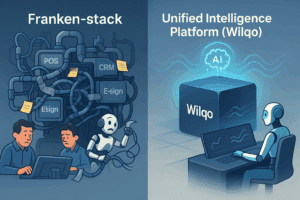
Soon, you weren’t running a mortgage company anymore. You were managing a messy web of logins, vendors, and data that didn’t talk to each other. People called it “best of breed,” but what you really had was a Franken-stack…a pile of different systems stitched together.
When generative AI came along, I was amongst the people who thought it would make this chaos worse. “Vibe coding” using plain English to build software seemed like it would create millions of tiny apps, each doing one narrow task really well.
But that’s not what’s happening…at least not at the AI-enabled companies like Wilqo. AI is doing the opposite; it’s helping to bring everything back together. And that’s good news.
The “Vibe Coding” Reality Check
The hard part of mortgage tech isn’t writing code. It’s following the rules. This industry runs on compliance, security, and complex guidelines. You can’t roll out new software until it passes audits, data checks, and investor requirements…and makes sense to the people doing the hard work of using your platform to originate loans.
So yes, AI can write code…but by itself, that has limited value.
The real breakthrough is that AI helps unified platforms update themselves almost as quickly as small point solutions.
Why does that matter? Because when the speed-to-features is close, the benefits of using a single platform far outweigh the benefits of stitching together many vendors.
Old, all-in-one systems used to be slow and expensive. Adding one new feature could take six months to a year. That’s why everyone turned to plug-ins and outside tools.
But AI changes the game. Today, a modern, unified platform can with team that understands how to apply AI can innovate nearly as fast as those point-solution vendors you have all over your process. Big systems can move fast as long as they’re designed the right way.
Why One Platform Beats Many
A single platform is all about efficiency and control.
1. Unified Intelligence
When your data is spread across five vendors, no one can see the whole picture. In a unified system, your users (and AI!) have complete visibility from lead to closing. That means fewer errors, smarter automation, and better insights.
2. Simplified Oversight
You already know the headaches that every extra vendor adds with more integration challenges, audits, and contracts to maintain. A single platform puts everything under one secure, accountable system. There really is value in the “one throat to choke” approach.
3. A Better Human Experience
Your team shouldn’t have to juggle a dozen logins. With one interface, everything’s in one place and AI can help across the entire workflow without losing context.
But Isn’t Modularity Better?
Yes, modularity still matters. It’s been the standard for years. In software, modularity equals speed and quality. But there’s a difference between modularity (well-designed building blocks) and fragmentation (a pile of disconnected tools). Sadly, you likely have the latter.
You can still have open APIs, connect to outside AI models, and add plug-ins. The key is having one strong foundation that ties it all together.
The modern unified platform is a base layer that supports both internal and external innovation under one consistent framework. It’s both unified and flexible.
The modern system is your Unified Intelligence Platform (UIP).
Charlie: The Unified Intelligence Platform in Action
This is where Wilqo’s Charlie comes in.
Charlie isn’t a return to old, rigid systems. It’s a platform designed to evolve. That lets an agile team of business analysts and developers conceive, spec, design, build, and test new features much faster than you’re used to.
But AI is not a rising tide that lifts all boats equally. It disproportionately benefits teams that don’t carry decades of spaghetti code and inconsistently designed codebases. Even AI can’t fix the rats nest of code they have. And where old platforms need to monetize their vendor integrations to justify their bloated dev teams, the AI-centered companies like Wilqo eliminate girth in favor of speed.
The era of endless apps and add-ons is ending. The cost of “glue” integrations, brittle APIs, and redundant data is simply too high.
“Best of breed” was a survival tactic for slow systems. That time is over. You need to stop paying for glue!